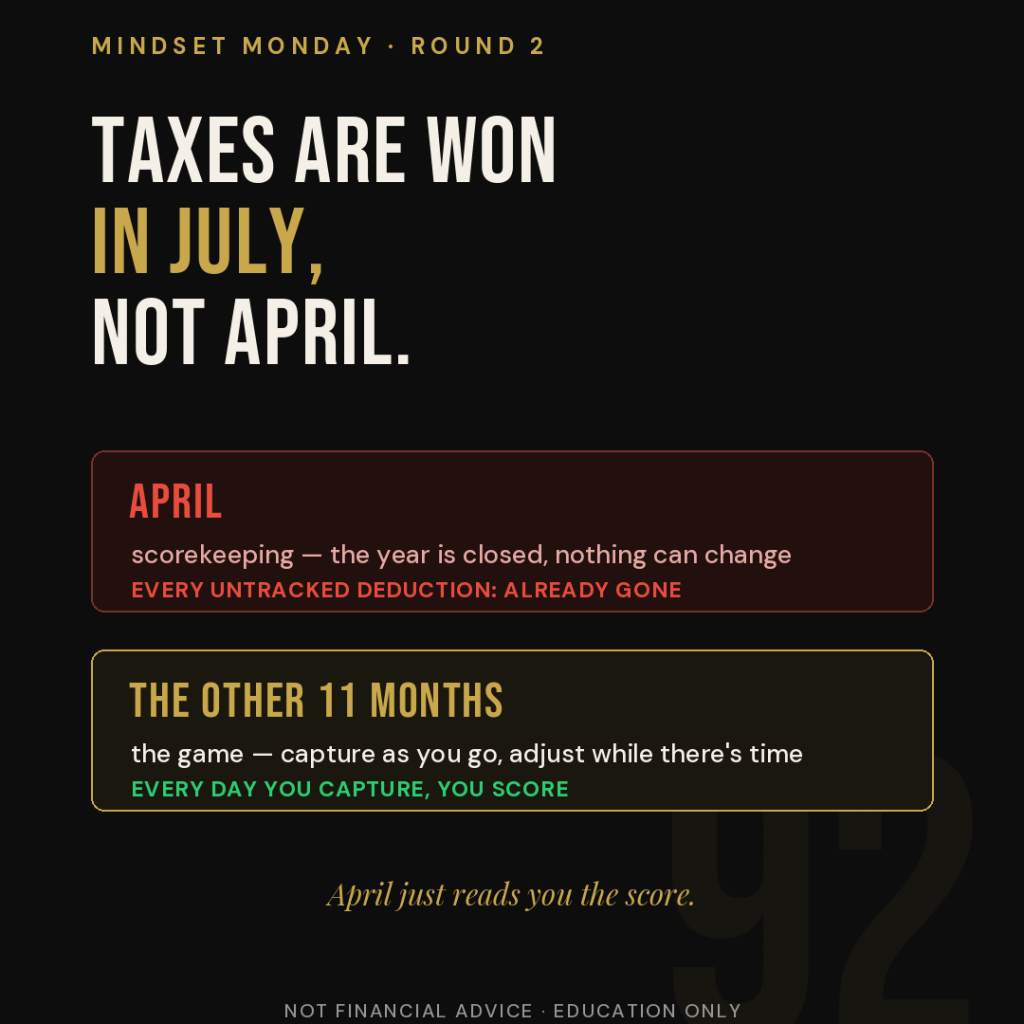
There’s a strange ritual in personal finance. Once a year, in the spring, millions of people sit down with their documents and discover — all at once, when nothing can be changed — how the previous year actually went. We call it tax season. It would be more honest to call it scorekeeping season, because by the time April arrives, the game is already over.
Every untracked business mile from last February? Gone. The work expense on the receipt that never got photographed? Gone. The deduction you were definitely going to remember? It died the moment you thought “I’ll remember that.” April doesn’t decide how much of your money you keep. The other eleven months decide that. April just reads you the score.
Which is why the most valuable fifteen minutes in your financial year don’t happen in the spring at all. They happen right about now.
The Mid-Year Tax Checkup
Halfway through the year, there’s still time to act — which turns the same questions that would be regrets in April into simple adjustments in July. Four of them cover most of what matters.
First: are you capturing as you go? Business mileage, work expenses, home-office costs, charitable giving — either these are being recorded as they happen, or they’re evaporating in real time. Deductions don’t die at tax time; they die in the moment, one forgettable event at a time. The fix was never a better memory or a heroic weekend with a shoebox of receipts. The fix is a capture system: the moment happens, it gets captured instantly and automatically, and a tax professional sorts out later what actually counts. Capture is your job; judgment is theirs.
Second: did your situation change? New side income, a move, a new family member, a new business — any of these can reshape a tax picture, and mid-year is when there’s still runway to adjust for it.
Third: is your withholding still tuned? If last spring brought either a giant refund or a scary bill, the dial may be set wrong — and July is a natural moment to review it.
Fourth, for anyone with side income: are quarterly estimated payments handled? If the honest answer is “I’m not sure,” that’s a one-conversation question for a tax professional, and a much cheaper conversation now than later.
The Most Beloved Myth in Personal Finance
While we’re being honest about April: a big tax refund is not a bonus. It isn’t a windfall, and it isn’t generosity. It’s your own money — overpaid throughout the year — returned to you late, at zero percent interest. A large refund means you extended an interest-free loan to the government for twelve months and then celebrated the repayment.
Consider what that money could have done in the meantime: covered bills, reduced a debt balance, sat in an emergency buffer, been invested. Instead it sat in someone else’s account while inflation quietly nibbled at it.
There is a fair counterargument. Some people genuinely value the refund as forced savings — “I’d just spend it otherwise” — and that’s a legitimate choice. The key word is choice. There’s a real difference between deliberately running a forced-savings strategy and accidentally running one at zero percent because the dial was never examined. If your refunds are consistently large, that isn’t a win streak; it’s a setting. Whether to change it is a personal decision with tradeoffs — exactly the kind worth discussing with a tax professional.
Widening Out: One Question Per Enemy
The mid-year checkup works because it converts an annual panic into a scheduled habit. And once you’re sitting down anyway, it takes only a few more minutes to review the whole board — one honest question for each of the five enemies of wealth.
Taxes: are deductions being captured as they happen? Inflation: is your value protected, or is all of your savings sitting somewhere it quietly melts? Debt interest: is the payoff on track — do you know your balances and rates today, and is the plan moving or drifting? Income: is the second stream growing? Even slow growth counts; zero movement in six months is an answer worth noticing. Volatility: is your dip plan written — one sentence, decided in calm weather, about what you’ll do when the market drops?
Fifteen minutes, twice a year. It isn’t glamorous, and that’s precisely why it works. Most people examine their finances once a year, under duress, when nothing can be changed. Running the review in July — on purpose, with half a year of runway — turns the same list of discoveries into a list of adjustments. That difference, repeated year after year, compounds like everything else.
The Kaizen Bottom Line
You don’t beat the first enemy of wealth with one heroic April. You beat it the way you beat all five: with small systems that run all year — a capture habit for the moments, a checkup for the settings, and a fifteen-minute review that keeps the whole machine pointed the right way. July is the halftime adjustment. April is just the final score.
Not financial advice — this is educational overview. Tax rules are jurisdiction- and situation-specific, and individual circumstances vary widely. Consult a qualified tax professional before making decisions about your own situation.
Jeremy Jenkins is a lifestyle and wealth coach and the founder of Kaizen Coaching. The Kaizen Wealth Operating System — a 15-chapter field manual for fighting back against all 5 enemies of wealth — is available at mykaizencoaching.com for $17.