Every month, a number gets announced, quoted, argued about, and turned into headlines: the inflation rate. And every month, millions of people hear that number and quietly assume it describes their life. It doesn’t — and the gap between that number and your reality might be the most practically important thing about the second enemy of wealth.
The headline inflation rate is an average — one figure blended across millions of households, hundreds of spending categories, and an imaginary “typical” basket of goods. It’s genuinely useful for economists. But you don’t live in an average. You live in a specific home, drive specific miles, feed specific people, and renew specific policies. Your inflation rate is made of your rent or mortgage costs, your grocery cart, your gas tank, your insurance renewals — and it can run dramatically hotter or cooler than whatever the news said this morning.
If you rent in a competitive market, commute long distances, and shop for a growing family, your personal rate has likely outrun the headline for years. If your housing costs are locked and your lifestyle is compact, you may be beating the average without knowing it. Either way, the number that governs your financial life isn’t broadcast on television. It’s printed on your receipts — and almost nobody ever measures it.
That’s the rule that changes the inflation fight: you can’t fight a number you’ve never measured.
The Personal Inflation Audit
Measuring your real rate takes about fifteen minutes, and it works in four steps.
Step one: pull three recurring bills. Choose the ones that dominate your budget — housing-related costs, insurance, phone, utilities, a streaming bundle. Inflation does its real damage in the big, repeating categories, so that’s where the audit looks.
Step two: compare each to a year ago. An old statement, an old email, last year’s renewal letter, even a year-old grocery receipt. No spreadsheet required — just this year’s number next to last year’s, side by side.
Step three: circle your creep categories. Some lines will have barely moved; others will have jumped. The two or three categories where your money is melting fastest are your personal inflation — not the economy’s version of it, yours.
Step four: attack the biggest two. This is where measurement becomes a fight. Renegotiate the renewal with one slightly awkward phone call. Downgrade the plan that quietly upgraded itself. Switch providers. You don’t need to battle every category — just the two costing you the most.
Most people have never run this exercise once in their lives. It takes fifteen minutes, and it replaces a vague sense of “everything’s more expensive” with a specific, addressable list.
The Price That Lies: Shrinkflation
One inflation tactic deserves special attention, because it’s engineered to defeat the exact habit careful shoppers are proudest of: checking prices.
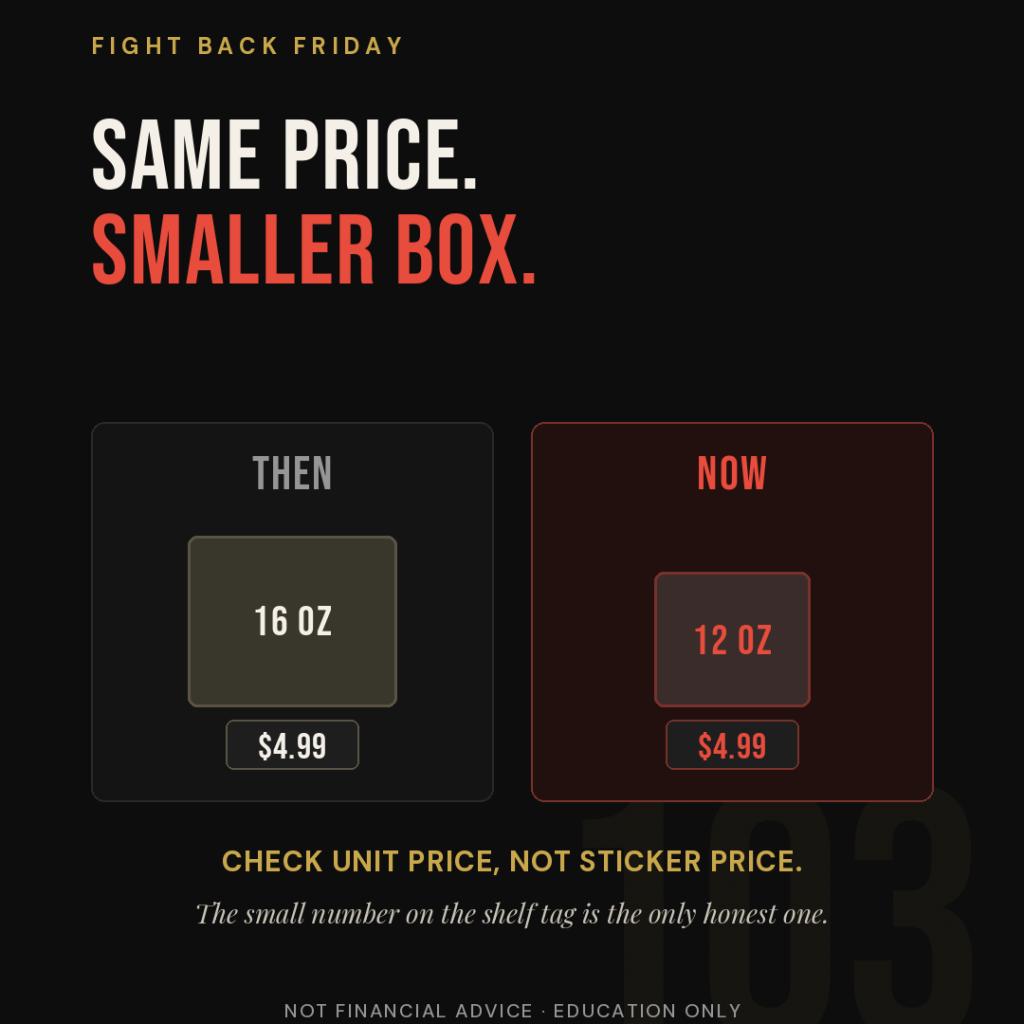
Shrinkflation works like this: the shelf price stays exactly the same — your brain checks it, recognizes it, and approves it — but the package shrinks. Fewer ounces, fewer sheets, more air in the bag. Same box, same price tag, less product. You’ve just paid more per unit, and the receipt will never admit it. It’s a price increase wearing camouflage, with the sticker price as the decoy.
The counter-move is almost embarrassingly simple: check the unit price, not the sticker price. Most shelf tags print it in small type — the cost per ounce, per sheet, per count. That small number is the only honest one in the store. It catches the shrink, it compares brands on equal footing, and it occasionally exposes the “value pack” that is somehow worse per unit than the regular size. Ten seconds of reading defeats inflation’s favorite disguise.
Both Ends of the Dollar — and the Way Out
A complete defense recognizes that inflation attacks a dollar twice: once when you spend it, and once while you save it. The spending end is defended by paying less for what you were buying anyway — the audit, the renegotiations, the unit prices, the smarter purchasing. The savings end is defended by making a deliberate decision about long-term value instead of accepting a default. Near-term cash is a buffer and should stay one; that’s its job. But letting one hundred percent of long-term value sit somewhere it quietly melts is a choice too — just an unexamined one. What the alternative looks like is personal, which makes it a question to answer thoughtfully, not an instruction to follow blindly.
And then there’s the honest limit of all of it: cutting has a floor. Bills can only be trimmed so far before you hit bone — the rent is the rent, and the groceries are the groceries. Earning has no such floor. The strongest inflation defense in existence is an income that grows faster than prices do, which is why the second enemy of wealth and the fourth — the single income — are really one campaign. Defend the dollars you have; build the machine that makes more of them.
The Kaizen Bottom Line
Assemble the week and it becomes one repeatable system: audit (measure your real rate), cut (attack the creep), protect (defend saved dollars deliberately), and outgrow (build income that rises faster than prices). Run it twice a year alongside a broader money review, and the enemy that wins by going unnoticed loses its best weapon. Inflation never announces itself — which means the fight starts, every time, with fifteen quiet minutes and a stack of your own receipts.
Not financial advice — this is educational overview. Saving and store-of-value decisions involve real risk and are highly personal. Consult a qualified professional for guidance specific to your situation.
Jeremy Jenkins is a lifestyle and wealth coach and the founder of Kaizen Coaching. The Kaizen Wealth Operating System — a 15-chapter field manual for fighting back against all 5 enemies of wealth — is available at Resources for $17.