Ask anyone what they earn and they’ll tell you to the dollar. Salary, hourly rate, take-home pay — we track the money coming in with obsessive precision. Now ask the mirror-image question: what do you pay in interest each month, across everything you owe? Nearly everyone goes quiet. The number that measures the third enemy of wealth — the single most corrosive line in most budgets — is a number most people have never once calculated.
That asymmetry isn’t an accident of laziness. Interest is uniquely easy to ignore because it’s the only bill that buys nothing. Rent buys shelter; groceries buy food; the phone bill buys connection. Interest buys the privilege of having borrowed — a product-free payment that hides inside a dozen statements instead of arriving as one honest invoice. And a blur, conveniently for the enemy, can’t be fought. A number can.
The Rate-Stack Audit
Finding your interest number takes about fifteen minutes, and it works in four steps.
Step one: list every balance. Every card, every loan, every buy-now-pay-later arrangement you’ve half forgotten. One page. This is the step people avoid for years, and it’s also the step that shrinks the monster — a debt you can see is just a problem, and problems have plans.
Step two: write the rate beside each balance. Statements and apps show it, usually labeled APR. The instruction here is strictly clerical: no editorializing, no wincing. Just writing.
Step three: sort the stack, highest rate to lowest. Now the page has a shape. The top of the stack is where interest bleeds fastest — and whatever payoff approach you eventually choose, this sorted view is the terrain map it will run on.
Step four: total one month of interest across everything. Recent statements show the interest charged each period; add them up. That total is your interest number — what the third enemy collects from you every month, for nothing.
Seeing the number usually stings for about ten minutes. Then something more useful replaces the sting: a target. There is no shame in any number, large or small. The only losing move is the blur.
A List Tells You What You Owe. A Map Tells You What to Do.
The audit produces a list — accurate, and motionless, like a photograph. Turning it into progress requires a map: something that answers the operational questions. Which balance gets attacked first? Where does every extra dollar go this month? Is the plan moving, or quietly drifting?
There are several honest ways to build the map, each with real strengths. The avalanche approach targets the highest rate first and is mathematically efficient. The snowball approach targets the smallest balance first and is psychologically powerful — early wins fund later discipline. Interest-cancellation strategies choreograph cash flow against balances and appeal to people who want the whole picture managed on one screen. None is universally “best”; the right map depends on your temperament, and the wrong map is whichever one you won’t actually follow.
The Minimum Payment Autopsy
One number deserves a dissection of its own, because it’s engineered to be misread: the minimum payment. It sits on the statement looking like guidance — reasonable, official — and so millions of people pay it faithfully and believe they’re paying their debt down.
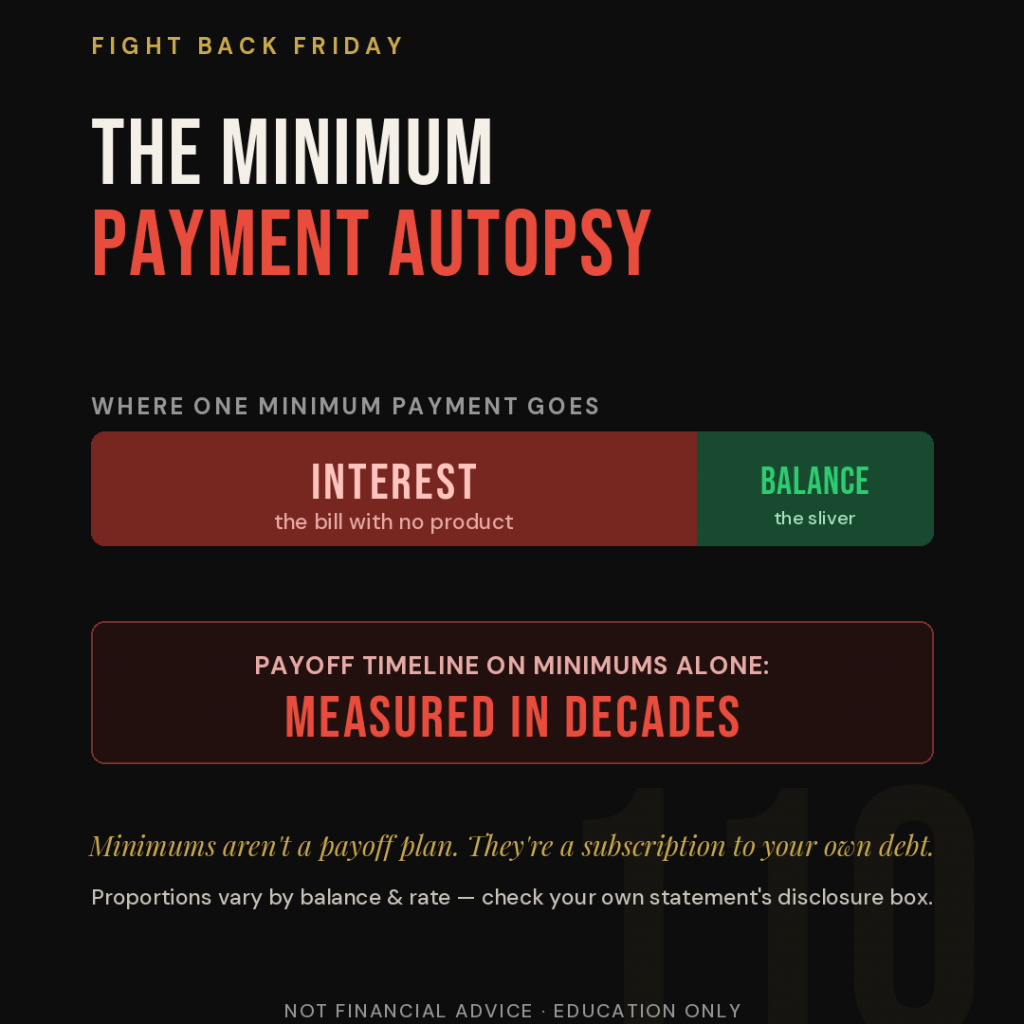
Open a statement and trace where a minimum actually goes. On a typical high-rate balance, the largest share feeds interest — the bill with no product — while a startlingly thin sliver touches the balance itself. That sliver is the only part doing the “paying down.” The statement even confesses the consequences: in the US, a legally required disclosure box shows the estimated payoff time if only minimums are paid. For many balances it’s measured in decades, with cumulative interest that can rival the original amount borrowed. (Exact proportions vary with balance, rate, and terms — which is precisely why the assignment is to read your own statement, not to trust anyone’s generic example.)
Minimums, in other words, aren’t a payoff plan. They’re calibrated to keep the account alive and the interest flowing — a subscription to your own debt. The counter is structural: every dollar sent above the minimum goes disproportionately to work on the balance itself, which is why the fuel question matters so much. Extra dollars come from cutting, which is real but has a floor, or from earning, which doesn’t — and a second income stream aimed entirely at one balance is among the fastest debt weapons there is. When the balance dies, the stream moves to the next target; the weapon outlives every battle it wins.
The Monthly Debt Check-In
Debt payoff rarely fails in a collapse. It fails in a drift: the plan made in a burst of motivation, the map that goes unopened, the extra payment skipped “just this month.” The antidote is a ten-minute monthly ritual. Know your number — is this month’s interest total smaller than last month’s? Pick one target — focus beats spread; concentrated attacks kill balances. Automate the extra — a standing order, not a monthly act of willpower. And watch the map bend — because a debt curve bending downward catches drift the month it starts and feeds motivation like nothing else.
A note that belongs in every honest conversation about debt: if your situation involves genuine hardship — collections, impossible minimums, income that can’t cover essentials — nonprofit credit counseling agencies exist for exactly that, and consulting one is a strong move, not a defeat.
The Kaizen Bottom Line
The third enemy of wealth wins by staying blurry. So the fight starts the way every fight in this system starts: with measurement. Fifteen minutes to find the number, one decision to build the map, one automation to fuel it, and ten minutes a month to keep it from drifting. Compounding doesn’t care whose side it’s on. Know your number, and start pointing it the other way.
Not financial advice — this is educational overview. Debt situations vary widely; no approach guarantees a timeline or outcome. Consult a qualified professional for guidance specific to your situation.
Jeremy Jenkins is a lifestyle and wealth coach and the founder of Kaizen Coaching. The Kaizen Wealth Operating System — a 15-chapter field manual for fighting back against all 5 enemies of wealth — is available at mykaizencoaching.com for $17.